Liposomal GLP-1 & oral GLP-1 delivery: an honest negative result

Liposomal GLP-1 and oral GLP-1 delivery describe a simple, powerful idea: wrap a GLP-1 receptor agonist (GLP-1 = glucagon-like peptide-1) inside a liposome1 — a lipid vesicle — so it can be swallowed and absorbed through the gut rather than injected. Panacea Bio Chem explored exactly this under the programme name Bioglutide.
Our conclusion, published here as a negative result: for a peptide this large, crossing the stomach and the intestinal barrier orally demands a heavy load of aggressive permeation enhancers, and enhancers powerful enough to admit the peptide also non-selectively loosen the epithelial barrier itself. Weighing that trade-off against the modest benefit, Panacea set the oral studies aside. We think publishing what did not work is a contribution too — so here is the full reasoning, with real numbers and real sources.
1. What is liposomal / oral GLP-1?
GLP-1 is an incretin — a hormone the gut releases after a meal that nudges the pancreas to release insulin, restrains glucagon, slows stomach emptying and quiets appetite. GLP-1 receptor agonists (the "-glutide" family, plus tirzepatide) copy that signal and have reshaped the treatment of type-2 diabetes and obesity. Almost all of them are injected, because they are peptides — short protein chains — and the digestive tract is built to take peptides apart.
The appeal of a swallowed GLP-1 is obvious: no needle, easier habit, wider reach. One route people reach for is the liposome — a tiny bubble whose wall is a lipid bilayer, the same architecture as a cell membrane. Liposomes are genuinely useful carriers elsewhere in medicine (intravenous formulations, and the lipid nanoparticles behind mRNA vaccines). The hope for liposomal GLP-1 is that the vesicle shields the peptide from the stomach and ferries it across the gut wall.
2. Why it matters — and why it is hard
Oral delivery of a peptide runs a four-part gauntlet, and each stage removes most of what is left:
| Barrier | What it does to a peptide |
|---|---|
| Gastric acid (pH ~1.5–3.5) | Denatures and helps hydrolyse the chain; pepsin cleaves peptide bonds |
| Proteolytic enzymes | Trypsin, chymotrypsin and brush-border peptidases chop the peptide into fragments |
| Mucus layer | A thick, renewing gel that traps and sweeps particles away before they reach cells |
| Epithelial tight junctions | The sealed seams between gut-lining cells; a large, water-loving peptide cannot slip through |
The net effect is stark. Across the peptides taken all the way to the clinic by this route, oral bioavailability lands around ~1%2 — that is, roughly ninety-nine parts in a hundred are lost before the drug reaches the blood.
3. The Rybelsus precedent (it can be done — narrowly)
Oral semaglutide (Rybelsus) is the existence proof: the first oral GLP-1 receptor agonist to reach approval.3 It works by co-formulating the peptide with a permeation enhancer called SNAC — salcaprozate sodium.4 SNAC raises the local pH right around the dissolving tablet, which quietens pepsin and protects the peptide, and it transiently fluidises the nearby stomach lining so a little of the peptide slips through. Two facts tell the whole story:
- The enhancer dwarfs the drug. A tablet carries a few milligrams of semaglutide alongside several hundred milligrams of SNAC.4
- The window is razor-thin. Even so, oral bioavailability is roughly 0.4–1%, and the dose only works if taken fasting, first thing, with no more than a small sip of plain water, then a wait before eating, drinking or other tablets.3
Rybelsus is a real achievement — and it also maps the edges of the possible. It shows the oral-peptide window is open, but only a crack, and only by loading the formulation with enhancer.
4. The permeation-enhancer trade-off
The whole field turns on one class of ingredient: intestinal permeation enhancers — SNAC, sodium caprate (C10), bile salts, acylcarnitines and surfactants.2 They work by transiently opening the tight junctions between gut cells and/or perturbing the cell membranes, so a big molecule can cross. The catch is written into the mechanism:
An enhancer strong enough to admit a large peptide is, by nature, non-selective. The same loosened barrier is open to whatever else is in the gut at that moment. Independent reviews note it remains unclear how well the epithelium's damage-and-repair keeps up under chronic, daily enhancer dosing.2 More enhancer buys more peptide — but also more barrier disruption. That is the trade-off, and it does not disappear by wrapping the peptide in a liposome.
Why not? Because a liposome alone does not answer the four barriers. Gastric acid and bile salts can destabilise the vesicle; digestive lipases and proteases attack both the lipid shell and the peptide; the mucus layer traps particles; and even an intact vesicle still meets the tight-junction wall. So a nanocarrier ends up needing the same permeation enhancers — and inherits the same trade-off. The full mechanism is here.

5. Panacea Bio Chem's angle — and its honest conclusion
Panacea Bio Chem researches oral and needle-free routes for fragile peptides, and the Bioglutide programme was our look at a liposome-encapsulated GLP-1 receptor agonist meant to survive the stomach and be absorbed by mouth. We treated the question seriously and followed it to a clear answer: for a peptide of this size, the enhancer burden needed to admit it across the intestinal barrier — and the barrier disruption that comes bundled with that enhancer — outweighed the convenience the oral route was supposed to buy. So we set the oral studies aside.
We are publishing that outcome on purpose. A negative result, stated plainly, is real knowledge: it saves the next team a wrong turn, and it is how honest science compounds. Panacea would rather tell you what did not work than dress a dead end as a breakthrough. The specific formulations, enhancer sets and read-outs behind this decision remain proprietary to Panacea Bio Chem and Bogdan Dicoias — but the reasoning, and the boundary, are shared in full.
6. The route that does work — by contrast
Step around the gut and the picture inverts. A subcutaneous injection bypasses acid, enzymes, mucus and tight junctions in one move — which is why nearly every GLP-1 in use is injected, at a tiny dose, with no enhancer burden at all. There the real problem is no longer absorption; it is preservation and clean reconstitution — keeping a delicate peptide intact from synthesiser to syringe, and mixing it fresh at the moment of use. That is precisely the ground Panacea builds on:
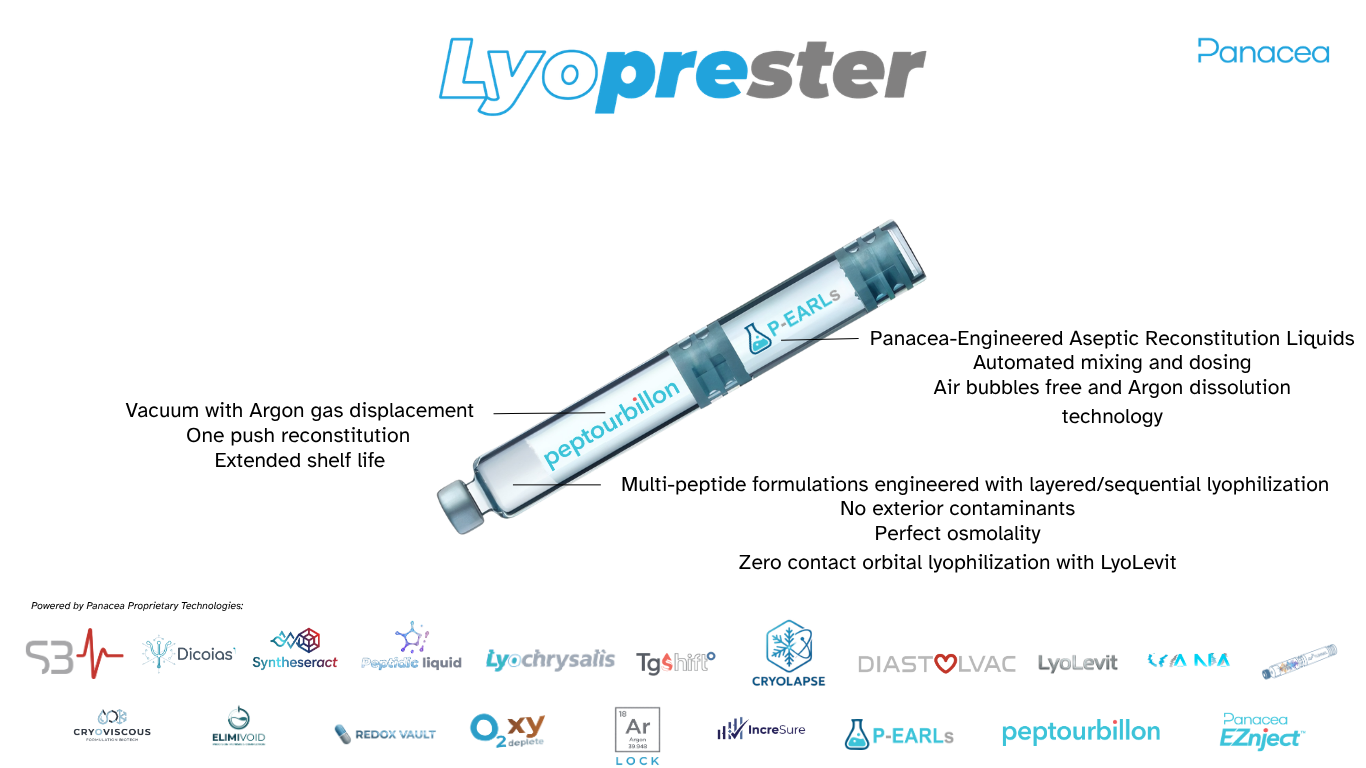
- Lyoprester® — the cartridge that carries its own solvent → keeps a dried peptide cake and its diluent apart until the instant of the dose.
- Peptourbillon™ — bringing the cake back to life, gently → is the reconstitution art that dissolves a cake cleanly, without the foaming and shear that damage a fragile chain.
- EZnject™ — mix fresh, then dose → wraps that cartridge in a pen that mixes and meters in a single, closed motion.
The delivery choreography, cold-chain handling and the hardware that make these repeatable stay behind Panacea's door — the outline is here; the recipe is not. More on the injectable / reconstituted route →
7. Where a needle-free peptide would matter most
We record these as directions worth the effort — the places where solving oral or needle-free peptide delivery would change the most lives, and where a preservation-first injectable route already helps today:
Frequently asked
What is liposomal or oral GLP-1?
It is the idea of wrapping a GLP-1 receptor agonist in a
liposome (a lipid vesicle) so it can be swallowed and absorbed through the gut instead of injected. The
obstacle is that oral peptide bioavailability sits near 1%, because gastric acid, digestive
enzymes, the mucus layer and epithelial tight junctions each remove almost all of the dose.
Why did Panacea Bio Chem set the Bioglutide oral study aside?
Because admitting a peptide
this size across the intestinal barrier needs a heavy load of aggressive permeation enhancers, and
enhancers strong enough to let the peptide through also non-selectively loosen the epithelial barrier.
Panacea judged the trade-off not worth it, and published the negative result openly.
Does oral semaglutide (Rybelsus) solve this?
It is the first oral GLP-1 receptor agonist,
and it works — narrowly. It pairs the peptide with the enhancer SNAC in a tablet where the
enhancer far outweighs the drug, still delivers only about 0.4–1% of the dose, and must be taken
fasting with a small sip of plain water. It shows both that the oral window exists and how narrow it is.
Trending in the field
Recent developments in the field — refreshed 2026-10-26 by Panacea Bio Chem.
- Parasympathetic dysfunction assessed by deep-breathing CVR-R is associated with early discontinuation of oral semaglutide in type 2 diabetes: A multicenter retrospective study — PubMed, 2026 Oct 24
- GLP-1-based therapies in cardiovascular disease: outcomes, mechanisms, and emerging clinical applications — PubMed, 2026 Oct 23
- Intestinal Macrophage-Mediated Exosomal Repackaging Establishes Bioactive Reservoirs for Long-Acting Oral Peptide Therapy — PubMed, 2026 Sep 29
- New Horizons for Incretin-Based Therapeutics — PubMed, 2026 Oct 23
References & further reading
- Liposome — structure and use as a drug carrier. Wikipedia.
- Brayden et al. Gastrointestinal permeation enhancers for the development of oral peptide pharmaceuticals — the ~1% bioavailability ceiling and the tight-junction / membrane trade-off. PMC (NIH).
- Oral semaglutide (Rybelsus) — first oral GLP-1 receptor agonist; fasting dose with a small sip of water; ~0.4–1% bioavailability. Wikipedia: Semaglutide · FDA review via FDA (accessdata).
- Twarog et al. Intestinal permeation enhancers for oral delivery of macromolecules: SNAC (salcaprozate sodium) vs sodium caprate (C10). Pharmaceutics 2019. PMC (NIH).
- SNAC (salcaprozate sodium) — the absorption enhancer in oral semaglutide. PubMed.